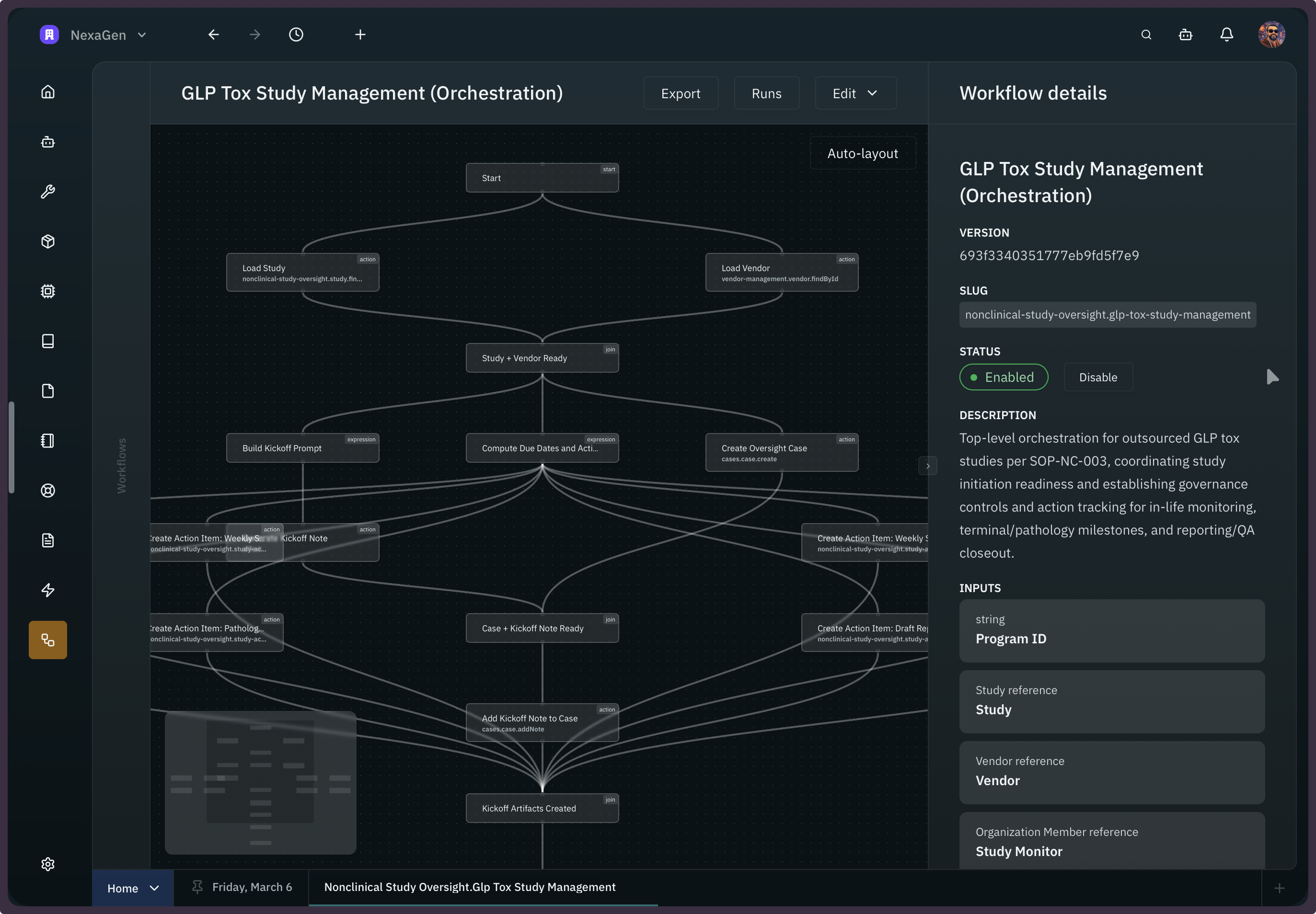
This workflow was designed in natural language and generated by AI. No consultants. No months-long implementation.
Your product has CI/CD, code review, and monitoring. Your operations run on Slack threads, spreadsheets, and someone's memory. Subduction closes that gap.
You apply extreme rigor to your product.
Then you run the actual company on duct tape.
This is operational drift: the growing gap between how your company was designed to run and
how it actually runs. Every spreadsheet is a process without an owner. Every Slack thread is a decision
without a record.
The duct tape accumulates until something breaks.
Subduction extracts the universal primitives of business operations and makes them composable, executable, and auditable.
Describe a process in natural language. Subduction generates the entities, workflows, and automations to execute it. Your documentation becomes your source of truth, not a fiction that drifts from reality.
Deploys directly into your Azure or AWS environment. No SaaS black box. You own your data completely. No vendor lock-in. Leave whenever you want. Your systems stay.
Stop maintaining documentation that nobody reads and processes that nobody follows. When your docs define your systems, keeping them current isn't discipline. It's automatic.
Entities, workflows, automations, decisions, conversations. The universal building blocks of operations, extracted into a foundation you can compose, extend, and reason about.
Most AI platforms throw agents at your problems and hope for the best.
We take a fundamentally different approach.
AI is the designer, not the runtime. You collaborate with AI to build workflows that execute with the speed, reliability, and auditability of code, not the unpredictability of a chatbot.
Collapse implementation timelines from months to weeks.
No consultants required.
Talk to Subduction the way you'd explain things to a new hire. It asks follow-up questions and builds a knowledge base from the conversation.
Subduction compiles from your knowledge base into executable entities, workflows, automations, and audit trails. Review, adjust, iterate.
Ship directly into your AWS or Azure environment. Your infrastructure, your data, your control. Production-ready from day one.
This workflow was designed in natural language and generated by AI. No consultants. No months-long implementation.
You're a CTO or technical co-founder at a product-first company. You've hit 15–30 people and suddenly the operations are held together by willpower. You know the duct tape is there. You know it's getting worse.
Investors are about to look under the hood. Your operations need to be as impressive as your product.
SOC 2, regulatory audits, banking requirements. You need audit trails that actually exist, not ones you reconstruct.
What worked at 8 people is breaking at 25. Processes are forking. Knowledge is siloed. Things are falling through cracks.
You don't want a 6-month implementation with an army of consultants. You want to ship operational infrastructure like you ship product.
Every company has a version of itself it intends to be and a version of itself that actually runs. We're closing the gap between the two.
Every process that lives in spreadsheets, Slack threads, and tribal knowledge, rebuilt as executable, auditable infrastructure.
Use AI to make that encoding fast enough that you don't need a six-month implementation timeline or an army of consultants to get there.
How a company intends to run and how it actually runs become the same thing. Documentation is the system. The system is the documentation.
We start where pain is acute and grow with our customers. Every engagement extracts patterns. Patterns
become templates. Templates become products.
The platform emerges from the problem.
We're starting with design partners at early-stage startups (roughly 5–30 people) who have outgrown spreadsheets and ad hoc processes but aren't ready for enterprise tooling.